
[Lived Experiences] Integrating Sepsis and Antimicrobial Resistance (September 2, 2026)
- Home >
- Information >
- News >
- [Lived Experiences] Integrating Sepsis and Antimicrobial Resistance (September 2, 2026)
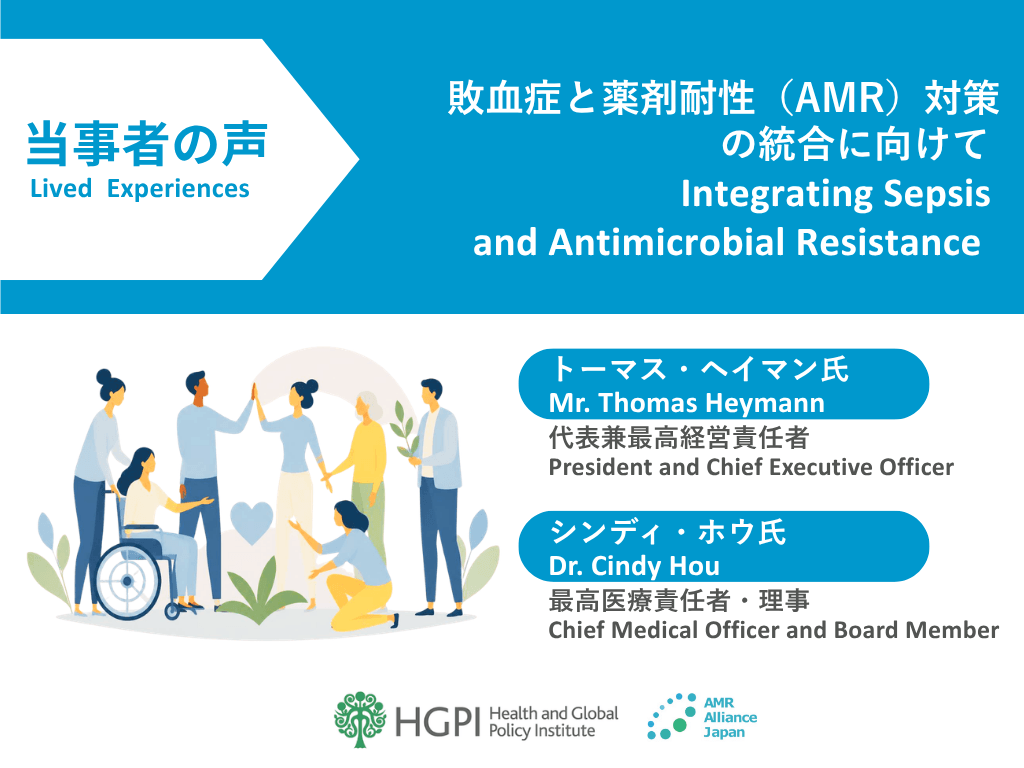
Mr. Thomas Heymann
President and Chief Executive Officer, Sepsis Alliance
Dr. Cindy Hou
Chief Medical Officer and Board Member, Sepsis Alliance
Aiming to advance policies to combat antimicrobial resistance (AMR), AMR Alliance Japan (Secretariat: Health and Global Policy Institute (HGPI)) has been engaged in joint action with people affected by AMR and those close to them in Japan and abroad. Since 2021, as part of this work, the Alliance has been gathering the voices and experiences of patients, people concerned by AMR, patient organizations, and citizens involved in AMR control. In this installment, Mr. Thomas Heymann and Dr. Cindy Hou of Sepsis Alliance, a US patient organization, discuss why sepsis and antimicrobial resistance cannot be addressed separately. Since its establishment in 2007, the organization has engaged both the general public and healthcare professionals to promote early recognition and effective treatment of sepsis, as well as actions against AMR. Mr. Thomas Heymann first became involved when he met Sepsis Alliance’s original founder, Carl Flatley, DDS, MSD, and heard Dr. Flatley’s story about how he lost his daughter to sepsis at the age of 23. Not long after, his own daughter’s best friend and his next-door neighbor both died of sepsis and cancer complications. Dr. Cindy Hou is an infectious diseases physician, and engages with antimicrobial stewardship and infection prevention over the years through clinical encounters with her patients. She serves as the Sepsis Alliance’s Chief Medical Officer and a member of its Board of Directors, working towards patient safety, equity, and language access.
Contents:
(1) AMR and Sepsis as Interconnected Challenges
(2) Building Public Awareness Through Accessible Communication
(3) From First Responders to Specialists
(4) When Patients Speak Up
(1) AMR and Sepsis as Interconnected Challenges
Without effective antimicrobials, infections become harder to treat and are more likely to progress to sepsis. For this reason, antimicrobial stewardship is central to Sepsis Alliance’s mission. When antimicrobials stop working, more infections progress to sepsis, which is why Dr. Hou explains that stewardship goes well beyond choosing an antibiotic: it means selecting the right one, adjusting as new information comes in, and minimizing side effects or complications.
Sepsis Alliance also integrates AMR into its education and advocacy work, emphasizing the need for funding for antimicrobial development, investment in rapid diagnostics, and clinical training to guide responsible antimicrobial use.
Each year, the organization hosts the Sepsis Alliance AMR Conference, which convenes clinicians, researchers, patients, and policymakers to explore practical solutions for countering AMR. The event provides a platform for disseminating innovation and strengthening the link between AMR prevention and sepsis care.
Mr. Heymann and Dr. Hou also mentioned the relevance of sepsis and AMR for children, pointing out that sepsis takes more children’s lives than cancer. Neonatal sepsis is also a serious concern.
(2) Building Public Awareness Through Accessible Communication
When Sepsis Alliance was established in 2007, only 19% of Americans had heard the term sepsis. Today, awareness has increased to 75%. This progress reflects nearly two decades of consistent national outreach focused on improving public understanding of sepsis as a medical emergency. With misinformation and vaccine skepticism on the rise, patient organizations like Sepsis Alliance are essential and serve as trusted messengers in health communication. Sepsis Alliance’s awareness activities include national campaigns, educational events, and partnerships with media and healthcare organizations. Each September, the organization leads Sepsis Awareness Month, during which hospitals, professional societies, and advocacy groups conduct coordinated activities to share information about sepsis prevention and early recognition. The organization also supports World Sepsis Day and World AMR Awareness Week, integrating sepsis messaging with global efforts to address antimicrobial resistance.
Sepsis Alliance has conducted multiple surveys to better understand stakeholder awareness of AMR. Surveys consistently show a lack of understanding across global populations. This data informed the development of Sepsis Alliance’s #EndSuperbugs campaign, which aims to educate and motivate people to take action against AMR.
A distinctive feature of Sepsis Alliance’s work is its emphasis on linguistic equity and health literacy. The organization develops multilingual resources — including content in Spanish, Chinese, and Tagalog — to reach populations with limited English proficiency (LEP).
Sepsis Alliance also employs plain-language communication and the “teach-back” method, encouraging healthcare professionals to confirm patients’ understanding by asking them to explain key information in their own words. These approaches help ensure comprehension and support better outcomes. Dr. Hou emphasizes that even English speakers can struggle with medical terminology, which is precisely why plain language matters. If people cannot understand what health professionals are saying, awareness campaigns will not be effective.
(3) From First Responders to Specialists
Early surveys conducted by Sepsis Alliance showed that many healthcare providers, particularly outside critical care settings, were unfamiliar with the signs and urgency of sepsis. To address this, Sepsis Alliance launched Sepsis Alliance Institute, a free, accredited online platform that offers continuing education courses on sepsis recognition, infection prevention, and antimicrobial stewardship. More than 65,000 healthcare professionals have participated in Sepsis Alliance Institute’s programs, with approximately 1,000 new learners joining each month. Training modules are designed for a wide range of professionals, including first responders, nurses, obstetricians, oncologists, and school nurses.
Dr. Hou emphasizes the importance of comprehensive training across the healthcare system, noting that half of sepsis patients arrive by ambulance and that everyone – from first responders to specialists – needs to recognize sepsis and act quickly.
These training efforts also need to address disparities that persist across race, income, and language, since medically underserved and minority populations remain less likely to have heard of sepsis or to receive timely care. Closing this gap requires data-driven approaches, culturally competent care, and workforce diversity — including language-concordant providers and community health workers who can build trust and navigate cultural barriers.
(4) When Patients Speak Up
Patient engagement is central to Sepsis Alliance’s mission. Survivors and their families play a vital role in raising awareness, influencing policy, and shaping communication. The ongoing “Faces of Sepsis” campaign features thousands of personal testimonies, which are shared through the organization’s website, social media, and public events. These stories have helped convey the human and societal impact of sepsis and have become a primary tool for outreach and education. As Mr. Heymann explains, patients are not just recipients of care but essential advocates, and when survivors tell their stories, it changes how people think about sepsis.
Mr. Heymann and Dr. Hou also note that while anyone can get sepsis, there are more vulnerable populations, such as those who are immunocompromised or have chronic illnesses and non-communicable diseases. AMR also poses a significant risk to people living with conditions such as cancer, diabetes, cystic fibrosis, and HIV/AIDS, underscoring the need for a cross-disciplinary discussion of AMR that transcends the boundaries of individual diseases. Meanwhile, the online platform Sepsis Alliance Connect provides education and peer support to over 5,000 members, helping survivors rebuild their lives while continuing to spread awareness. As Dr. Hou puts it: “When a patient survivor speaks, it commands attention. Their experiences remind policymakers and clinicians of what’s at stake.”
Case Reports on Antimicrobial Resistance (AMR)
Case study 01
Dr. Keiji Okinaka(Director of Infection Control and Prevention Section, National Cancer Center Hospital East / Department of General Internal Medicine, National Cancer Center Hospital East /Division of Hematopoietic Stem Cell Transplantation, National Cancer Center Hospital)
“A disseminated filamentous fungal infection that broke through echinocandin antifungal treatment”
Case study 02
Dr. Shogo Otake and Dr. Masashi Kasai (Department of Infectious Diseases, Hyogo Prefectural Kobe Children’s Hospital)
“AMR can affect newborns! A 5-month-old boy with a urinary tract infection caused by AMR bacteria”
Case study 03
Dr. Takashi Ueda (Department of Infection Control and Prevention, Hyogo College of Medicine Hospital)
“Candidemia Requires Routine Ophthalmologic Evaluation!”
Case study 04
Dr. Akari Shigemi(Division of Pharmacy / Department of Infection Control and Prevention, Kagoshima University Hospital)
“The importance of proper antimicrobial use for MRSA infections – Beware of rifampicin monotherapy induced resistance”
Case study 05
Dr. Keisuke Kagami (Department of Pharmacy, Hokkaido University Hospital)
Dr. Mitsuru Sugawara (Department of Pharmacy, Hokkaido University Hospital / Laboratory of Pharmacokinetics, Faculty of Pharmaceutical Sciences, Hokkaido University)
“Concomitant piperacillin-tazobactam and vancomycin use increases the risk of acute kidney injury”
Case study 06
Dr. Keisuke Kagami (Department of Pharmacy, Hokkaido University Hospital)
Dr. Mitsuru Sugawara (Department of Pharmacy, Hokkaido University Hospital / Laboratory of Pharmacokinetics, Faculty of Pharmaceutical Sciences, Hokkaido University)
“Thrombocytopenia Can be Avoided By Monitoring Linezolid Blood Levels – Enabling Long-Term Linezolid Use for the Successful Treatment of Refractory Pyogenic Spondylodiscitis”
Case study 07 – Lived Experiences
Ms. Sachiko Ito (Supporter, AMR Alliance Japan / Person Affected by Non-tuberculous Mycobacterial (NTM) Lung Disease)
“I hope more healthcare professionals take an interest in Antimicrobial Resistance (AMR) and work to promote the appropriate usage of antimicrobials”
Case study 08
Dr. Koji Masuda (Vice Chief Pharmacist, Department of Pharmacy, International Healthcare and welfare University, NARITA Hospital)
Dr. Kenji Ikeda (Chief Pharmacist, International Healthcare and welfare University, NARITA Hospital / Deputy Director, Department of Pharmacy, Narita Hospital, International University of Health and Welfare)
“TDM Is Not Only for Safety, but for Ensuring Effectiveness”
Case study 09 – Lived Experiences
Mr. Junichi Maruyama (Former Ambassador of Japan to Serbia)
“Experiences with Eye Disease and AMR”
Case study 10 – Lived Experiences
Dr. Tatsuya Ukawa (Physician, Médecins Sans Frontières)
“AMR Control in Conflict Zones: Challenges and New Perspectives on AMR Control in Conflict Zones as Seen in Medical Practice in the Gaza Strip”
Case study 11 – Lived Experiences
Dr. Kristine Morlven (Physician, Oslo University Hospital)
“Lymphoma, Sepsis, and Reflections on the Role of Patient Advocacy in Antimicrobial Resistance”
Case study 12 – Lived Experiences
Ms. Pernilla Rönnholm (Founder, Miracle – Association for Families of Preterm Infants)
“Integrating Neonatal Care and Antimicrobial Resistance”
