[Research Report] AMR Policy Update #7: The New Global Action Plan on AMR (Part 2)
- Home >
- Information >
- News >
- [Research Report] AMR Policy Update #7: The New Global Action Plan on AMR (Part 2)
 <POINTS>
- The 2026–2036 GAP-AMR, developed by the Quadripartite (WHO, FAO, WOAH, UNEP), has been expanded from five to six strategic objectives (adding governance, sustainable financing, and accountability), and emphasizes prevention through vaccination, infection control, WASH, and stewardship.
- After the draft was postponed at the WHO Executive Board in February 2026, Member States resolved debates on intellectual property and technology transfer with consensus language on knowledge sharing, leaving the balance between equitable access and sustainable innovation a defining tension for the plan’s ten-year horizon.
- Japan is well placed to demonstrate continued leadership in AMR. Building on its National Action Plans (NAP) and integrated surveillance, Japan can deepen cross-ministry environmental monitoring, adopt costed and measurable targets in its next NAP, and support Asia-Pacific capacity-building, complemented by civil society platforms.
Overview of the New GAP-AMR (2026–2036)
The GAP-AMR for 2026–2036 is a joint product of the Quadripartite, signaling a consolidated transition to a holistic One Health approach that places the environmental dimension on equal footing with human and animal health. Compared with the 2015-2025 plan, the updated GAP-AMR responds to recommendations from the WHO Evaluation Office’s comprehensive review and incorporates lessons learned regarding integrated surveillance, supply chain resilience, and the importance of strengthened primary health care for infection prevention and rational antimicrobial use.
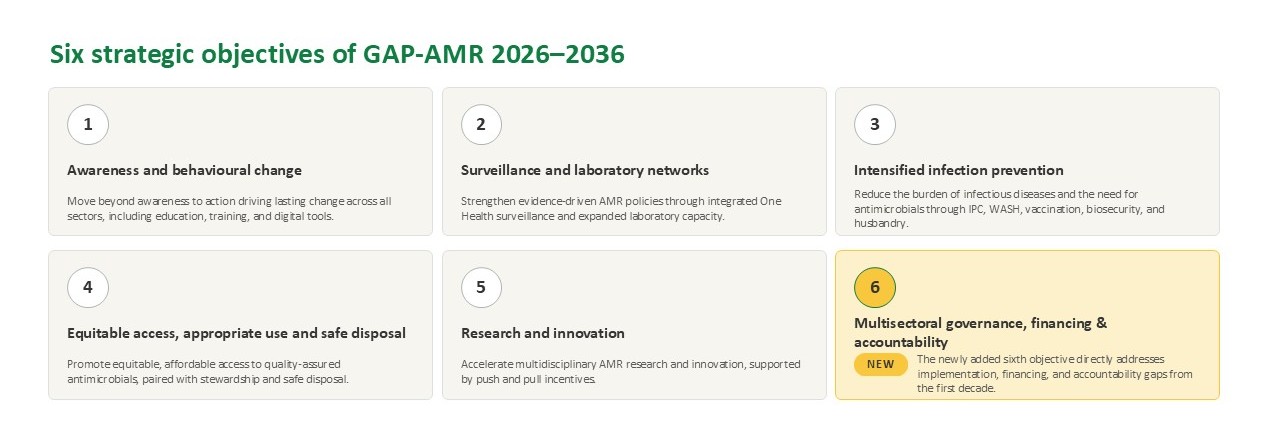
A key structural shift is the expansion from five to six strategic objectives, adding multisectoral governance, sustainable financing, and accountability to address implementation and financing gaps documented over the past decade. Whereas the 2015 plan positioned prevention as the third goal, the 2026–2036 plan gives greater prominence to prevention as a guiding principle throughout the entire action plan.
Within a prevention-first approach, vaccination sits alongside infection prevention and control, water, sanitation, and hygiene, and antimicrobial stewardship as a core element in AMR policy. The plan identifies low immunization coverage as a key driver of AMR and calls on Member States to strengthen national immunization programs to reduce preventable infections, antimicrobial use, and resistance. These efforts are aimed at achieving the goal of reducing deaths related to bacterial AMR by 10% to 2030, which was set forth in the 2024 UN Political Declaration and carried forward in the new GAP-AMR. It was estimated that scaling up investment in prevention, alongside appropriate antimicrobial use and safe disposal, could avert over 110 million deaths and generate nearly US$1 trillion in economic gains between 2025-2050. Equitable access mechanisms are also reinforced, including through the SECURE initiative on sustainable access to antibiotics.
The GAP-AMR’s Path to Adoption
The revision process originated in the Political Declaration adopted at the UN General Assembly High-Level Meeting on AMR in September 2024 which requested the Quadripartite (WHO, FAO, WOAH, UNEP) to revise the GAP-AMR by 2026. However, the negotiation process required extended consultations among Member States, with adoption of the draft initially postponed at the 158th session of the WHO Executive Board in February 2026.
One of the principal areas of discussion involved provisions related to intellectual property (IP) and technology transfer, reflecting longstanding global health policy debates on balancing innovation incentives with equitable access.
Some Member States raised concerns that language framing technology transfer as occurring on a “voluntary and mutually agreed” basis could limit options for strengthening regional generic manufacturing capacity and ensuring access to essential health technologies in LMICs during emergencies. Other Member States and pharmaceutical industry associations emphasized that established mechanisms for voluntary cooperation on research, development and technology transfer have historically supported a sustainable innovation pipeline. Following months of consultations, Member States reached a compromise text that refers to “the promotion of knowledge sharing and the transfer of AMR-related technologies, respecting international and national rules in line therewith.” Reaching a balance between equitable access, sustainable innovation, and timely implementation will likely remain a central theme throughout the plan’s ten-year horizon.
Implications for Japan: Domestic Policy Progress and Global Leadership
Japan has consistently positioned itself as a leading contributor to the global AMR agenda. Hosting the G7 Ise-Shima Summit in 2016, Japan helped place AMR at the center of the G7 health discussions, and during its 2023 G7 presidency, the Hiroshima Leaders’ Communiqué reaffirmed commitments to strengthening the antimicrobial pipeline, promoting equitable access, and supporting research and development through mechanisms such as the Combating Antibiotic-Resistant Bacteria Biopharmaceutical Accelerator (CARB-X), the Global Antibiotic Research and Development Partnership (GARDP). The private sector is also involved in advancing research and development through initiatives such as the AMR Action Fund. Japan is also a founding partner of the Global Health Innovative Technology (GHIT) Fund, which has supported R&D for malaria, tuberculosis, and neglected tropical diseases, including drug-resistant infections relevant to LMICs in the Asia-Pacific.
In response to the 2015 GAP-AMR, Japan formulated its first National Action Plan on AMR (2016–2020), which uniquely added a sixth pillar for international cooperation alongside the five global strategic objectives. The plan drove a substantial reduction in oral antimicrobial sale (approximately 32.7% by 2021) through physician-targeted stewardship programs, public awareness campaigns, and financial incentives for antimicrobial stewardship in medical institutions. Part of this decline has been attributed to reduced visits during the COVID-19 pandemic rather than to stewardship alone, underscoring the need for continued vigilance especially in the post-pandemic era.
As in many high-income settings, however, progress under Japan’s first NAP was uneven across indicators. Reductions in oral antibiotic use were not matched in parenteral (injectable) use in hospital settings, and resistance rates for some priority pathogens, including fluoroquinolone-resistant E. coli, continued to rise during the NAP1 period. These findings informed the design of Japan’s second National Action Plan (NAP2, 2023–2027), which retains the six-pillar structure while strengthening genomic surveillance under a One Health framework, recognizing the need to explore market incentives to support the antibiotic R&D pipeline, and continuing emphasis with infection prevention and control (IPC) and vaccination. Nippon AMR One Health Report (NAOR) annual publications now consolidate human, animal, food and environmental data, providing one of the more integrated national AMR datasets in the Asia-Pacific region.
Looking ahead, several implications for Japan are worth highlighting. First, the 2026–2036 GAP-AMR’s emphasis on sustainable financing and accountability suggests that Japan’s next NAP cycle may benefit from explicit, costed implementation plans with measurable indicators aligned with the goal of reducing bacterial AMR-related deaths by 10% by 2030. At the same time, as the era of the Sustainable Development Goals nears its term, there is also a strong case for Japan to help shape post-2030 goals especially for AMR. Second, the strengthened environmental dimension of the One Health approach—including monitoring of antimicrobial residues in wastewater and agrifood systems—creates opportunities for closer coordination across the Ministry of Health, Labour and Welfare; the Ministry of Agriculture, Forestry and Fisheries; and the Ministry of the Environment through initiatives such as monitoring antimicrobial residues in wastewater and agricultural food systems. Finally, Japan’s role in the Asia-Pacific positions it well to support regional capacity-building on surveillance, laboratory networks, and antimicrobial access. These will be essential to translating WHA79 commitments into implementation at country level.
Beyond government, civil society and multistakeholder platforms also have a part to play. AMR Alliance Japan (for which Health and Global Policy Institute (HGPI) serves as secretariat), together with HGPI’s policy dialogues, policy recommendations, and municipality- and community-level awareness activities, demonstrates how non-governmental and subnational engagement can complement national action and remain aligned with the global direction set at WHA79.
Conclusion
With the adoption of the 2026–2036 GAP-AMR on 23 May 2026, the Seventy-ninth World Health Assembly marks a significant milestone in the global AMR response. The updated plan addresses the principal limitations of its predecessor by combining clearer numeric targets aligned with the 2024 UN High-Level Meeting Political Declaration, an institutionalized One Health architecture through the Quadripartite, and a stronger emphasis on equity, access and prevention. At the same time, observers have noted areas warranting continued attention, including limited dedicated guidance for AMR in conflict-affected settings, and the persistent intersection between AMR and substandard or falsified antimicrobials. Ultimately, whether the updated framework delivers on its ambition will depend less on the language adopted in Geneva than on the financing, accountability mechanisms, and country-level implementation that follow. For Japan, as for other Member States, the coming decade offers an opportunity to consolidate domestic gains, strengthen regional cooperation in the Asia-Pacific, and contribute to a more equitable global system for preserving the effectiveness of antimicrobials for future generations.
References
- World Health Organization. (2026, May 13). Draft updated global action plan on antimicrobial resistance 2026-2036 (A79/5 Add.2). Seventy-ninth World Health Assembly, Provisional agenda item 12.9. https://apps.who.int/gb/ebwha/pdf_files/WHA79/A79_5Add2-en.pdf
- World Health Organization. (n.d.). SECURE: Expanding sustainable access to antibiotics. Retrieved May 21, 2026, from https://www.who.int/initiatives/secure-expanding-sustainable-access-to-antibiotics
- Sassmannshausen, F. (2026, February 4). Intellectual property dispute stalls WHO decision on global AMR strategy. Health Policy Watch. https://healthpolicy-watch.news/ip-dispute-halts-global-amr-strategy/
- World Health Organization Regional Office for the Western Pacific. (2025). Japan’s AMR response 2013–2025: Developing, implementing and evaluating national AMR action plans. https://iris.who.int/handle/10665/380481
- AMR One Health Surveillance Committee. (2025, April 18). Nippon AMR One Health Report (NAOR) 2024. Ministry of Health, Labour and Welfare. https://www.mhlw.go.jp/content/10900000/001466659.pdf
- Ministry of Health, Labour and Welfare, Japan. (2023). National Action Plan on Antimicrobial Resistance (AMR) 2023–2027. https://www.mhlw.go.jp/content/10900000/001096228.pdf
- G7. (2016, May 27). G7 Ise-Shima Leaders’ Declaration. Ministry of Foreign Affairs of Japan. https://www.mofa.go.jp/files/000160266.pdf
- The Government of Japan. (2016). National action plan on antimicrobial resistance (AMR) 2016–2020. Ministry of Health, Labour and Welfare. https://www.mhlw.go.jp/file/06-Seisakujouhou-10900000-Kenkoukyoku/0000138942.pdf
- Ono, A., Koizumi, R., Tsuzuki, S., Asai, Y., Ishikane, M., Kusama, Y., & Ohmagari, N. (2022). Antimicrobial use fell substantially in Japan in 2020—The COVID-19 pandemic may have played a role. International Journal of Infectious Diseases, 119, 13–17. https://doi.org/10.1016/j.ijid.2022.03.019
- Tsuzuki, S., Koizumi, R., Matsunaga, N., & Ohmagari, N. (2023). Decline in antimicrobial consumption and stagnation in reducing disease burden due to antimicrobial resistance in Japan. Infectious Diseases and Therapy, 12(7), 1823–1834. https://doi.org/10.1007/s40121-023-00829-7
- Muraki, Y., Kusama, Y., Tanabe, M., Hayakawa, K., Gu, Y., Ishikane, M., Yamasaki, D., Yagi, T., & Ohmagari, N. (2020). Impact of antimicrobial stewardship fee on prescribing for Japanese pediatric patients with upper respiratory infections. BMC Health Services Research, 20, Article 399. https://doi.org/10.1186/s12913-020-05288-1
- Okubo, Y., Nishi, A., Uda, K., Miyairi, I., Michihata, N., Kumazawa, R., Matsui, H., Fushimi, K., & Yasunaga, H. (2023). Financial incentives for infection prevention and antimicrobial stewardship to reduce antibiotic use: Japan’s nationwide observational study. Journal of Hospital Infection, 131, 89–98. https://doi.org/10.1016/j.jhin.2022.09.027
- Kusama, Y., Tsuzuki, S., Muraki, Y., Koizumi, R., Ishikane, M., & Ohmagari, N. (2021). The effects of Japan’s National Action Plan on Antimicrobial Resistance on antimicrobial use. International Journal of Infectious Diseases, 103, 154–156. https://doi.org/10.1016/j.ijid.2020.11.158
- AMR One Health Surveillance Committee. (2024). Nippon AMR One Health Report (NAOR) 2023. Ministry of Health, Labour and Welfare. https://www.mhlw.go.jp/content/10900000/001268945.pdf
Authors
Gail Co (Program Specialist, Health and Global Policy Institute)
Eri Cahill (Associate, Health and Global Policy Institute)
Yui Kohno (Manager, Health and Global Policy Institute)
