

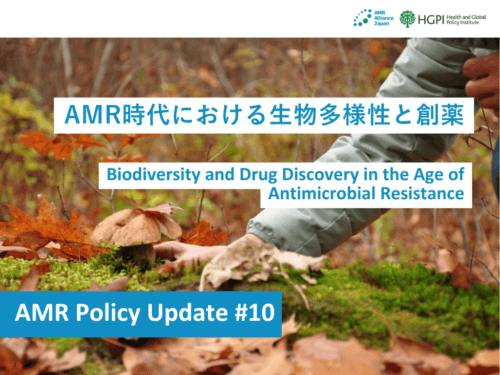
[Research Report] AMR Policy Update #10: Biodiversity and Drug Discovery in the Age of Antimicrobial Resistance (November 4, 2026)
- Home >
- Information >
- News >
- [Research Report] AMR Policy Update #10: Biodiversity and Drug Discovery in the Age of Antimicrobial Resistance (November 4, 2026)
 <POINTS>
- Natural resources are essential for drug discovery, but their diversity is rapidly disappearing. Over 50% of medicines originate from natural products, yet the organisms they come from are estimated to be going extinct about 1,000 times faster than they would without human activity. Each species lost may take with it compounds whose value as medicines has never been tested.
- Biodiversity loss and antimicrobial resistance are interconnected crises. When environmental change and other pressures destroy habitats, they also deplete the microbial diversity needed to search for new antibiotics, making it even harder to develop treatments for newly emerging resistant pathogens.
- Japan’s natural resources have long supported efforts against AMR, but their potential remains underused. From the postwar period through the 1990s, Japanese researchers are reported to have discovered more than 100 antibiotics and other bioactive substances from the country’s diverse microbial and plant resources. Novel compounds active against resistant bacteria have also been found in Japanese ecosystems in recent years, which makes biodiversity conservation important for AMR strategies as well.
Many antimicrobials in use today originated from natural organisms or were modeled on natural structures. As species and ecosystems disappear, the potential for developing new medicines also shrinks, which could further narrow the pipeline of antibiotic candidates just as resistant pathogens continue to spread. This policy column therefore looks at biodiversity not only as an environmental issue but from the perspective of drug discovery against antimicrobial resistance (AMR), and considers why a biodiversity perspective is indispensable to AMR drug discovery.
Nature as the Foundation of Medicine
For thousands of years, people have found substances in nature that led to new medicines. Compounds produced by plants, animals, and microbes have been used directly as medicines, and their complex molecular structures have also guided the design of new drugs.
These benefits from nature are not a thing of the past and continue to support modern medicine. Over 50% of medicines approved worldwide originate from natural products. In the nearly four decades from January 1981 to September 2019, more than 25% of approved anti-infective agents were either natural products or direct natural product derivatives.
Nature also offers unique and complex molecular structures that serve as templates for designing and synthesizing compounds, making it possible to develop compounds that would be difficult to design from scratch. These structures, known as natural product scaffolds, form the core of many drug molecules and play an important role in developing innovative drugs to combat multidrug-resistant bacteria.
Biodiversity has greatly expanded the possibilities for drug discovery. Historically, plants have been the single greatest source of natural product drugs, with about 9% of Earth’s roughly 374,000 plant species used medicinally. Beyond land, the oceans also hold resources that remain largely unexplored. Marine natural products (MNPs) have garnered significant attention in recent years, leading to the discovery of nearly 8,500 compounds with promising biological activity. Marine organisms, including animals and microbes, are also expected to be a source of new anti-cancer drug candidates.
From an AMR perspective, microorganisms deserve particular attention. Many major antibiotics, including penicillin, were discovered in microorganisms, and nine of the 13 major antibiotic classes are reported to be derived from microorganisms such as bacteria and fungi. However, many microorganisms remain understudied, particularly within biodiversity hotspots, which are areas that contain at least 1,500 species of vascular plants found nowhere else on Earth and have lost 70% or more of their original vegetation. These areas are rich in biodiversity but are affected by environmental destruction and change. Even so, they still hold great potential for finding new antimicrobial candidates against resistant bacteria.
Japan’s Biodiversity: History and Potential for Drug Discovery
Penicillin, an antibiotic derived from Penicillium mold, was discovered in the United Kingdom in 1928 and mass-produced in the United States during World War II. In Japan, full-scale domestic production began in 1946, and by 1949 the country was producing enough penicillin to meet domestic demand. This success spurred extensive research into antibiotics and other substances in Japan, and at least 117 antibiotics and other bioactive substances of Japanese origin are reported to have been discovered between 1946 and 1995, with 41 of these agents licensed out around the world.
Representative antibiotics discovered in Japan’s natural environment include colistin (polymyxin E, 1949), the first antibiotic discovered in Japan, and kanamycin (1957). Arbekacin, a semisynthetic aminoglycoside developed in Japan from kanamycin B, has also been used since 1990 to treat methicillin-resistant Staphylococcus aureus (MRSA) infections.
Japanese researchers continue to search for antibiotics in the country’s biodiversity today. For instance, lysocin E, a new natural antibiotic candidate, was identified in 2014 from a soil sample collected in Okinawa. Because lysocin E kills bacteria through a unique mechanism, it is expected to offer a new alternative to vancomycin, the current standard treatment for MRSA. These examples show that exploring and conserving Japan’s diverse natural environments is important for discovering novel compounds to combat AMR.
Biodiversity Loss and Its Impact on AMR
Although biodiversity is an indispensable foundation for drug discovery, it is declining rapidly. Modern extinction rates are estimated to be about 1,000 times higher than they would be without human activity, leading to an irreversible loss of resources that could support future drug development. Each species lost takes with it the chance to find substances that could someday be used as medicines.
Beyond species extinction, pollution, habitat destruction, and climate change are also altering the environments in which organisms live. These changes affect the diversity of microorganisms, an important source of new antibiotics. As existing antimicrobials become ineffective, the demand for new ones intensifies, yet the options for discovering them continue to narrow.
Compounding these environmental challenges are shifts in pharmaceutical research priorities, which have made it harder to find new medicines in natural products. Natural products research was once one of the pillars of drug discovery. Since the 1990s, however, changes in the business environment and advances in drug discovery technology have led many major pharmaceutical companies to shift their R&D emphasis away from traditional natural products discovery, which searches for active compounds in microorganisms and other organisms in nature. Their focus moved to high-throughput screening (HTS) of synthetic compound libraries, compound generation through combinatorial chemistry, and target-based drug discovery using gene and protein information. As a result, investment in natural products research has declined in relative terms in the antibiotic field as well, and natural products drug discovery is increasingly carried out by academia and startups rather than pharmaceutical companies.
In recent years, advances in new technologies such as AI and metagenomic analysis have made natural products research quicker and cheaper, and are making microbes that were previously difficult to culture more available. As a result, natural products drug discovery is attracting renewed attention from an AMR perspective. However, many major pharmaceutical companies have withdrawn from antibiotic R&D because of poor profitability and other factors, leaving much of this work to small companies, and public support and new financing mechanisms that could sustain AMR drug discovery are not yet adequately in place. These remain major challenges.
Many antimicrobials in use today are based on substances derived from nature, and Japan has produced several antibiotics from its own microbial resources. As resistant bacteria spread and existing antimicrobials become less effective, the need for new ones continues to grow. Yet the biodiversity that could yield new candidates is being lost, many major pharmaceutical companies have stepped back from natural products research and antibiotic R&D, and public support for AMR drug discovery remains insufficient. How to protect biodiversity and how to sustain the research that explores it are important questions not only for addressing AMR but also for maintaining Japan’s drug discovery capacity in the years ahead.
References
- Cao, S., & Kingston, D. G. I. (2009). Biodiversity conservation and drug discovery: Can they be combined? The Suriname and Madagascar experiences. Pharmaceutical Biology, 47(8), 809–823. https://doi.org/10.1080/13880200902988629
- Woo, S., Marquez, L., Crandall, W., Risener, C., & Quave, C. L. (2023). Recent advances in the discovery of plant-derived antimicrobial natural products to combat antimicrobial resistant pathogens: Insights from 2018–2022. Natural Product Reports, 40(7), 1271–1290. https://doi.org/10.1039/d2np00090c
- World Health Organization & Secretariat of the Convention on Biological Diversity. (2015). Connecting global priorities: Biodiversity and human health: A state of knowledge review. World Health Organization & Secretariat of the Convention on Biological Diversity. https://www.cbd.int/health/SOK-biodiversity-en.pdf
- Lee, V. (2018). Microbial transformations: The Japanese domestication of penicillin production, 1946–1951. Historical Studies in the Natural Sciences, 48(4), 441–474. https://pure.mpg.de/rest/items/item_3071029_11/component/file_3325900/content
- Yagisawa, M., Foster, P. J., & Kurokawa, T. (2015). 我が国において抗生物質医薬品の品質基準の果たした役割に関する薬史学的・公衆衛生学的考察:第2報 ペニシリン及びストレプトマイシンの国産化の達成 [Historical and public health perspectives on the role of quality standards for antibiotic products in Japan: Part 2, achieving domestic production of penicillin and streptomycin]. 薬史学雑誌, 50(2), 131–142. https://www.jstage.jst.go.jp/article/jjhp/50/2/50_131/_article/-char/ja
- 松本邦男 [Matsumoto, K.]. (2019). 国産ペニシリン開発史:深部培養の温故知新 [History of domestic penicillin development in Japan]. 生物工学会誌, 97(7). https://sbj.or.jp/wp-content/uploads/file/sbj/9707/9707_branch_spirit.pdf
- Kumazawa, J., & Yagisawa, M. (2002). The history of antibiotics: The Japanese story. Journal of Infection and Chemotherapy, 8(2), 125–133. https://doi.org/10.1007/s101560200022
- Matsumoto, T. (2014). Arbekacin: Another novel agent for treating infections due to methicillin-resistant Staphylococcus aureus and multidrug-resistant Gram-negative pathogens. Clinical Pharmacology: Advances and Applications, 6, 139–148. https://doi.org/10.2147/CPAA.S44377
Hamamoto, H., & Sekimizu, K. (2015). カイコの細菌感染モデルを利用して同定された新規の抗生物質ライソシンE [Lysocin E, a novel antibiotic identified using a silkworm model of bacterial infection]. ライフサイエンス新着論文レビュー. https://doi.org/10.7875/first.author.2015.005 - Hamamoto, H., et al. (2015). Lysocin E is a new antibiotic that targets menaquinone in the bacterial membrane. Nature Chemical Biology, 11(2), 127–133. https://doi.org/10.1038/nchembio.1710
- World Health Organization. (2025, February 18). Biodiversity. https://www.who.int/news-room/fact-sheets/detail/biodiversity
- Pimm, S. L., Jenkins, C. N., Abell, R., Brooks, T. M., Gittleman, J. L., Joppa, L. N., Raven, P. H., Roberts, C. M., & Sexton, J. O. (2014). The biodiversity of species and their rates of extinction, distribution, and protection. Science, 344(6187), 1246752. https://doi.org/10.1126/science.1246752
- Newman, D. J., & Cragg, G. M. (2020). Natural products as sources of new drugs over the nearly four decades from 01/1981 to 09/2019. Journal of Natural Products, 83(3), 770–803. https://doi.org/10.1021/acs.jnatprod.9b01285
- Erwin, P. M., López-Legentil, S., & Schuhmann, P. W. (2010). The pharmaceutical value of marine biodiversity for anti-cancer drug discovery. Ecological Economics, 70(2), 445–451. https://doi.org/10.1016/j.ecolecon.2010.09.011
- Convention on Biological Diversity. (2021, June 29). Pharmaceuticals and biodiversity: To protect ourselves we must safeguard our planet. https://www.cbd.int/article/pharmaceuticals-biodiversity-planet
- World Health Organization. (2019). Ten threats to global health in 2019. https://www.who.int/news-room/spotlight/ten-threats-to-global-health-in-2019
- Laird, S. A. (2013). Bioscience at a crossroads: Access and benefit sharing in a time of scientific, technological and industry change – The pharmaceutical industry (Policy Brief). Secretariat of the Convention on Biological Diversity. https://www.cbd.int/abs/doc/protocol/factsheets/policy/abs-policy-brief-pharma-web2-en.pdf
- Atanasov, A. G., Zotchev, S. B., Dirsch, V. M., the International Natural Product Sciences Taskforce, & Supuran, C. T. (2021). Natural products in drug discovery: Advances and opportunities. Nature Reviews Drug Discovery, 20(3), 200–216. https://doi.org/10.1038/s41573-020-00114-z
- World Health Organization. (2025). Analysis of antibacterial agents in clinical and preclinical development: Overview and analysis 2025. https://www.who.int/publications/i/item/9789240113091
Acknowledgments
Kenji Sudo (Division of Innovative Research and Development, Department of Basic Research for Medical Innovation, Japan Agency for Medical Research and Development)
Akihiko Fujie (East Japan Coordination Group, Division of Strategic Planning and Evaluation, Department of Innovative Drug Discovery and Development, Japan Agency for Medical Research and Development)
We would like to express our sincere gratitude for the many helpful comments and suggestions we received in preparing this report.
Authors
Gail Co (Program Specialist, Health and Global Policy Institute)
Eri Cahill (Associate, Health and Global Policy Institute)
Yui Kohno (Manager, Health and Global Policy Institute)
